The Korea Tourism Organization Monday released its forecast for 2026 on Monday, projecting that travel to the country will be marked by individuals tailoring their plans to reflect individual tastes, rather fitting into than simple overall tourist categories.
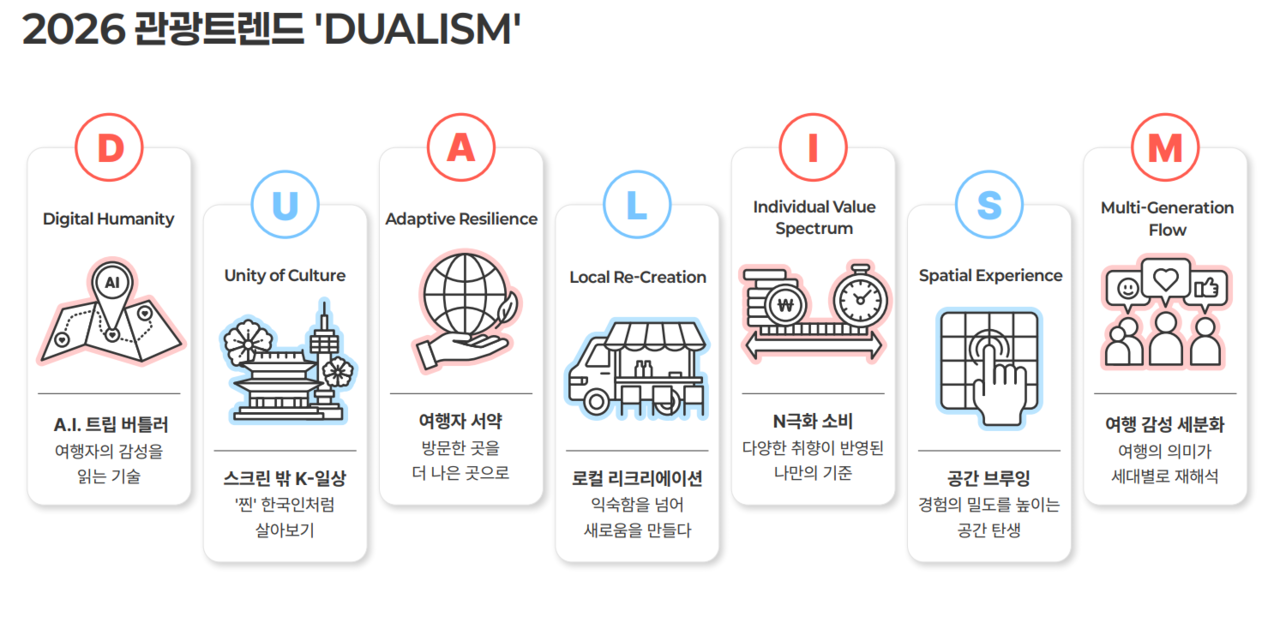
The forecast, presented as “D.U.A.L.I.S.M.,” is based on a three-year analysis of overall shifts in the travel enviroment, mobile and credit card data, social media patterns, expert interviews and consumer surveys.
The report highlights several factors driving the change. It predicts that artificial intelligence, once focused on convenience, will become more like a companion, capable of sensing travelers’ moods and easing the burdens of planning, allowing visitors to focus more on human interactions.
Interest in Korean culture is also deepening beyond screen-based consumption, as more international visitors look to experience everyday Korean life — eating, dressing and living like locals rather than merely visiting filming locations or cultural venues.
Sustainability and ethical travel are poised to strengthen as well. As climate concerns intensify, travelers are projected to adopt a regenerative mindset, seeking trips that contribute positively to the destinations they visit. This shift accompanies a broader rise in local-centric travel, where simple, everyday elements such as neighborhood restaurants, old shops and community customs are reinterpreted as cultural assets.
Consumer behavior is also fragmenting. Instead of traditional polarization between luxury and budget travel, visitors are expected to mix things up: selectively splurging on experiences they value while saving on others.
Meanwhile, physical spaces such as cultural venues and pop-ups are being reimagined as immersive attractions that blend media art, design and participatory installations to heighten the density of experience.
Generational differences are expected to further shape the travel industry. Wellness, for instance, serves as emotional healing for younger travelers but functions as a form of self-care and emotional management for older generations, illustrating how the same trend diverges across age groups.
“Korea’s tourism ecosystem will continue to evolve as technological advancement intertwines with human-centered sentiment, and as global currents merge with regional identity. We plan to collaborate with local governments and industry partners to respond to shifting traveler expectations and develop targeted marketing strategies for 2026,” said an official from KTO.
link