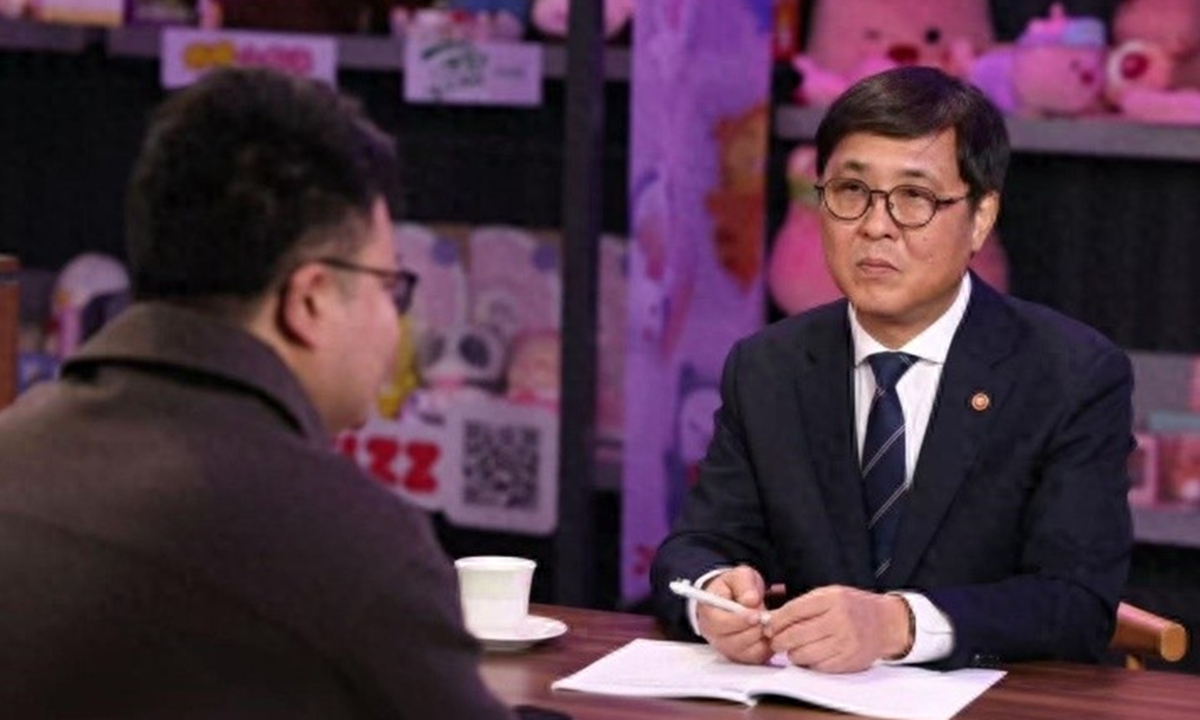
Seo Won-seok, the president of the Tourism Sciences Society of Korea (TOSOK) delivers an opening speech during the group’s press conference in Seoul, Thursday. Korea Times photo by Lee Hae-rin
Tourism experts outline policy agendas to shift Korea’s tourism focus from visitor numbers to high-value growth
Korea’s tourism industry will be reshaped this year by a stronger focus on sustainability, wider use of artificial intelligence (AI) and more customized travel experiences, the Tourism Sciences Society of Korea (TOSOK) said Thursday, unveiling its first annual vision under the slogan “RED UNICORN,” to mark the Year of the Red Horse.
At a New Year’s press conference in Seoul, TOSOK President Seo Won-seok said 2026 marks “a great turning point when the entire industry ecosystem must be overhauled,” driven by simultaneous shifts in AI, sustainability standards, demographics and intensifying global competition.
“The key task is not only to achieve the quantitative goal of 30 million inbound visitors, but to connect that achievement to qualitative growth in the structure and content of Korean tourism,” he said, stressing that visitor volume alone does not guarantee competitiveness.
Seo said Korea must move beyond a model centered on short-term visits and their associated shopping and lodging to one that “refines the very content and methods of tourism” through convergence with food, medical, wellness, K-beauty, MICE, sports and culture.
He also described AI as “core infrastructure” for improving efficiency and expanding global reach, pointing to its growing role in demand forecasting, pricing, personalized recommendations and language services.
Heo Jun, a professor at Dongduk Women’s University who led the society’s trend study, said TOSOK’s outlook differs from reports by the Korea Tourism Organization and private research firms, which focus mainly on traveler preferences and market sentiment.
“Our projection is centered on policy agendas and structural blueprints that government, academia and businesses can use to redesign Korea’s tourism ecosystem,” Heo said.
The study is based on an in-depth survey of more than 200 tourism professors nationwide. TOSOK summarized the results using the acronym “RED UNICORN” to talk about 10 themes that it said should guide Korea’s tourism transition in 2026.
Professor Heo Jun of Dongduk Women’s University introduces 2026 tourism trends during TOSOK’s press conference in Seoul, Thursday. Korea Times photo by Lee Hae-rin
The first pillar, “Regenerative tourism for regional resilience,” calls for tourism that helps address local depopulation and economic decline.
“Domestic travel, regional co-prosperity and dispersing foreign tourists into local areas must become non-negotiable policy agendas,” Heo said.
“Embedded AI and digital tourism experiences” calls for artificial intelligence and digital tools to become an invisible but constant layer of travel, shaping everything from trip planning and navigation to payment and on-site discovery.
“Domestic and inbound tourism synergy” emphasizes that foreign and local tourism should grow together, with international visitors boosting pride in Korean culture and encouraging Koreans to rediscover destinations at home.
Under “Ultra-personalized travel OS,” TOSOK envisions systems that read individual context and behavior patterns to design hyper-tailored itineraries, prices and services. Heo pointed to younger travelers who “increasingly want to create their own journeys” using home-sharing and lifestyle-focused stays, arguing that real-time data and context analysis are needed at both the central and local government levels.
The “Integrated wellness tourism” trend aims to turn Korea’s booming beauty and medical tourism into longer stays, “life-care” packages that combine clinics with local wellness assets. Recent industry data suggest international visitor spending on medical and related wellness services in Korea surpassed 2 trillion won last year, up more than 60 percent from 2024.
Other pillars include “Converged contents for K-fandonomy,” which promotes blending K-dramas, education programs, gastronomy and local IP into fandom-driven experiences and agendas for open innovation, routinized ESG practices and next-generation talent development.
“The structured infrastructure that can orchestrate this era of industrial convergence is still education,” Heo said, calling for government, local authorities and companies to jointly build new pipelines for tourism workers.
link