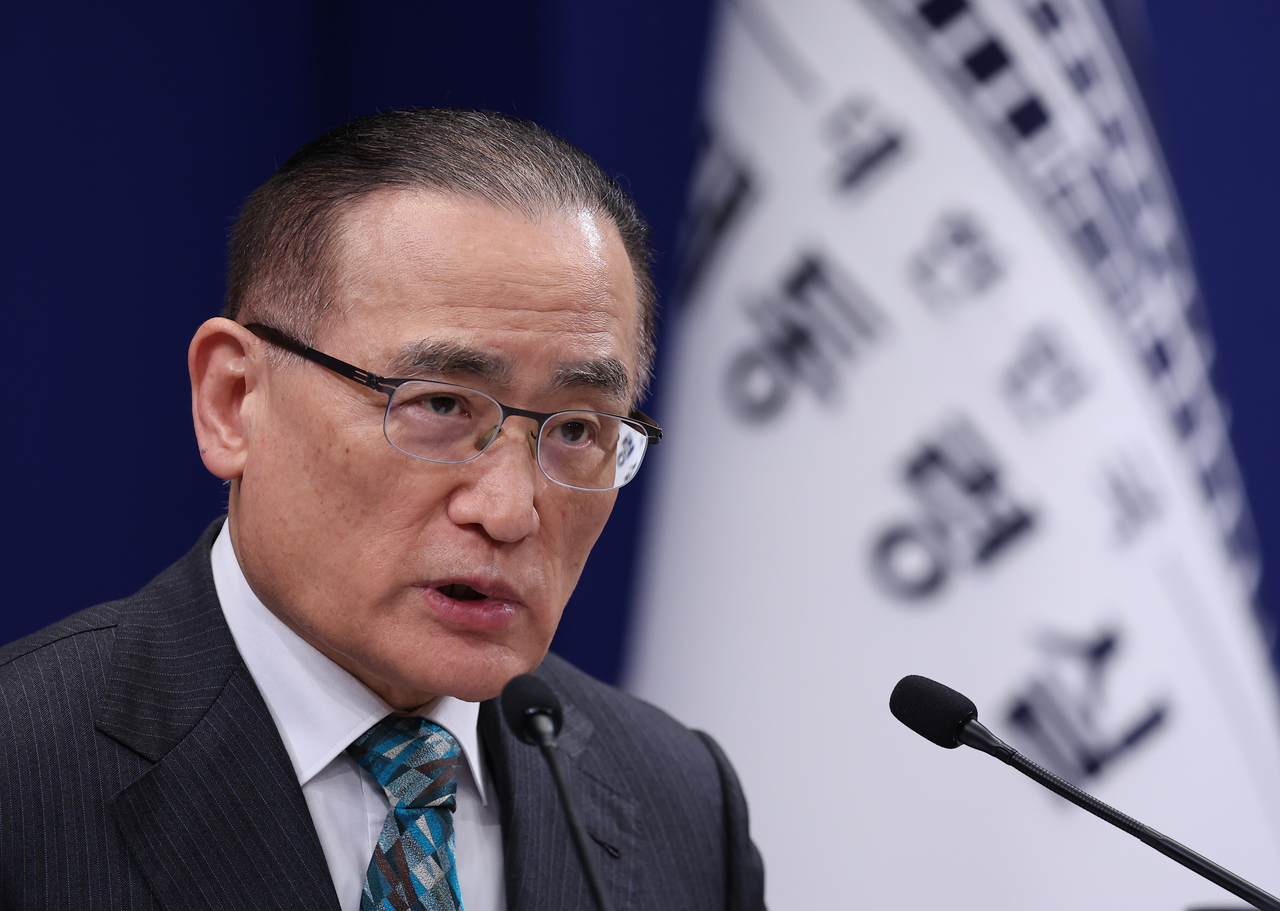
South Korea-US coordination to advance a bilateral agreement on Seoul’s greater independence in uranium enrichment, spent fuel reprocessing and nuclear-powered attack submarines will kick off early next year, a top presidential aide revealed in a briefing Wednesday.
Director of national security Wi Sung-lac said a US delegation will visit South Korea “as early as possible next year to engage in discussions on the security issues outlined in the joint fact sheet, topic by topic,” referring to trade and security issues outlined in the fact sheet signed between the two countries in November.
He added that no single official will likely represent the working-level US delegation because each security-related topic is under the jurisdiction of a different US secretary.
The two countries will also likely set a time frame to review progress on those matters, possibly in the second half of next year, said Wi, urging South Korea to speed up coordination because of the midterm elections in the US in November next year.
Wi, who met US officials including White House national security adviser Marco Rubio and US Secretary of Energy Chris Wright last week, also noted that a separate, stand-alone pact concerning South Korea’s control over its nuclear-powered submarines will be needed to override the existing nuclear energy agreement between Seoul and Washington.
This will be modeled after Australia’s bid to acquire nuclear-powered submarines after seeking an exemption under Section 91 of the US Atomic Energy Act, he said. The current 123 Agreement, effective since 2015, restricts nuclear material from being transferred to South Korea for military purposes.
Wi’s remarks follow a weeklong trip to three countries: the United States, Canada and Japan. He departed Seoul on Dec. 16 and returned Monday.
During his visit to Washington, Wi highlighted President Lee Jae Myung’s repeated stance that South Korea’s nuclear enrichment and spent fuel reprocessing will come along with Seoul’s commitment to nuclear nonproliferation, and that none of South Korea’s new class of nuclear-powered submarines will be powered by uranium enriched to 20 percent or more.
Moreover, acknowledging that the Lee administration’s past six months of efforts to mend ties with Pyongyang “barely yielded a fruitful outcome,” Lee’s top security aide said his Washington visit also focused on the two countries’ possible breakthrough in frozen ties with Pyongyang.
“With various diplomatic momentum in sight in the first half of next year, South Korea and the US discussed ways to coordinate on North Korea policy to resume dialogue with Pyongyang,” Wi said.
This is an apparent reference to US President Donald Trump’s planned state visit to China for talks with Chinese President Xi Jinping in April, but Wi did not specify which diplomatic events he meant by “momentum.”
On his visit to Ottawa, Canada, to meet his Canadian counterpart Nathalie Drouin and Ottawa’s chief of staff Marc-Andre Blanchard, Wi said South Korea and Canada agreed on strategic cooperation in areas such as cyber technology, artificial intelligence and economic security.
He also briefed them on South Korea’s strengths in submarine construction and its road map to contribute to strengthening Canada’s national defense capabilities.
Wi saw South Korea as being behind in the competition with Germany when it comes to its level of security cooperation with Canada, unlike in the fields of submarine construction technology and investment capacity.
“It’s difficult to regard (South Korea) as having an advantage over our competitor from that perspective. We are not a full member of the North Atlantic Treaty Organization, and Canada and other competitors are part of NATO,” Wi said.
South Korea and Germany are considered bidding countries for Canada’s submarine acquisition project to replace its four Victoria-class submarines with 12 new vessels.
link