South Korea Music Tourism Market Summary
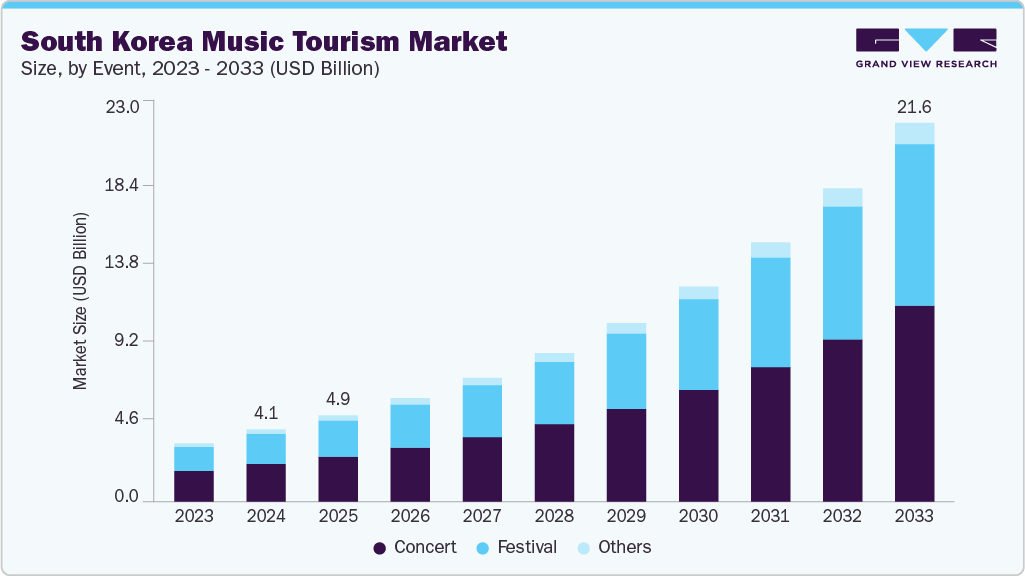
The South Korea music tourism market size was estimated at USD 4,114.8 million in 2024 and is projected to reach USD 21,579.3 million by 2033, growing at a CAGR of 20.3% from 2025 to 2033. The industry constitutes a dynamic segment of the country’s cultural tourism sector, driven predominantly by the global influence of K-pop, traditional music, and vibrant live performance culture.
Key Market Trends & Insights
- By event, the concert segment held the highest market share of 52.33% in 2024.
- Based on the age group, the 18 – 34 years segment held the highest market share in 2024.
- Based on the booking mode, the online travel agencies segment held the highest market share in 2024.
Market Size & Forecast
- 2024 Market Size: USD 4,114.8 Million
- 2033 Projected Market Size: USD 21,579.3 Million
- CAGR (2025-2033): 20.3%
As the Korean Wave (Hallyu) continues to gain momentum, music-related travel has become a strong motivator for international and domestic tourists alike. Major events such as KCON, the Seoul Music Awards, and BTS-related experiences in Seoul and Busan attract thousands annually, significantly boosting regional economies.
The integration of music with tourism policy is one of the key enablers. Government-led initiatives, including the “Visit Korea Year” campaigns and collaborations with entertainment agencies, have helped institutionalize music tourism within the broader cultural agenda. Music-themed attractions, such as the K-pop museums, hologram theaters, and dedicated Hallyu streets in Gangnam and Hongdae, have been developed to enrich visitor experiences.
Demand is further influenced by digital engagement. Platforms like YouTube and V Live have globalized fan access to Korean music, creating a digitally primed tourist base that seeks physical immersion in Korea’s music scene. These tech-savvy fans often pursue tailored itineraries, including concert tours, pop-up events, and visits to filming locations of music videos and reality shows.
However, the market encounters challenges such as high dependence on a few major artists, short event durations, and uneven regional distribution of music-related infrastructure. Efforts to diversify offerings beyond Seoul, into cities like Gwangju and Daegu, are underway to mitigate saturation and foster inclusive tourism growth.
Furthermore, the industry reflects a fusion of pop culture appeal, strategic branding, and immersive fan engagement, supported by both private innovation and public policy alignment. Sustainable expansion will depend on balanced development, regional inclusivity, and continued global interest in Korean music, which will have a direct impact on the music tourism industry in the country.
The market has evolved into a specialized and strategically curated segment within the country’s broader cultural tourism strategy. It is no longer limited to concerts or entertainment events but now encompasses a rich array of niche experiences shaped by fan behavior, content consumption trends, and government-led cultural diplomacy. The Korea Tourism Organization (KTO) has increasingly recognized the economic significance of music-driven travel, leading to the creation of dedicated campaigns and tourism assets designed specifically for international fans.
Fan-based tourism, particularly among K-pop enthusiasts, forms the backbone of this niche market. These travelers are highly motivated and willing to spend substantially on unique experiences, including exclusive merchandise, themed accommodation, and site-specific tours linked to idol culture. According to KTO data, over 22% of Japanese tourists in 2023 cited K-pop and Hallyu-related reasons for visiting South Korea. With the global K-pop fandom exceeding 156 million and cultural exports contributing about 0.3% of national GDP, this fan segment is both culturally impactful and economically potent.
Urban development strategies have also been aligned with music tourism goals. While Seoul remains the dominant destination, attracting around 80% of music-related international tourists, secondary cities like Busan and Jeju have shown strong growth. Busan’s “NewJeans Code in Busan” series is one such example, drawing over 23.8 million hours of online engagement in a short span and increasing on-site tourist activity. These campaigns effectively convert digital fandom into physical tourism, demonstrating the power of localized content in dispersing tourism flows beyond the capital.
The South Korean government has also expanded music tourism into hybrid cultural products. The “Feel the Rhythm of Korea” video campaign fused modern music with traditional visuals from different regions, gaining over 240 million YouTube views. Offline, the 2024 K-tourism roadshows in New York, LA, and Chicago were instrumental in reviving U.S. inbound tourism, with arrivals surpassing pre-pandemic levels, reaching 1.08 million by early 2024. These initiatives exemplify the effectiveness of content diversification and destination branding.
Specialty music events have become central to niche tourism development. Festivals such as the DMZ Peace Train Music Festival and the Jarasum International Jazz Festival have drawn genre-specific travelers in large numbers, with the latter attracting over 200,000 attendees annually. These festivals not only reinforce Korea’s position in global cultural diplomacy but also promote sustainable tourism in provincial regions, aligning with national objectives for regional revitalization.
Technology has played a critical role in enabling personalized and traceable tourism experiences. As part of the “Visit Korea Year 2023-2024” initiative, AI-generated content, QR-guided tours, and idol-led travel videos were introduced to enhance engagement. These tools facilitate itinerary customization, real-time updates, and digital interactivity, key factors in serving the evolving expectations of younger, tech-savvy tourists. KTO campaigns using generative AI amassed over 225 million views globally, indicating high resonance with digital audiences.
Underlying this success is a robust network of public-private partnerships. Strategic collaborations, such as appointing NewJeans as KTO tourism ambassadors and hosting roadshows in collaboration with entertainment agencies, have positioned K-pop not just as cultural content but as a structured economic driver. Seoul’s tourism plan aims to attract 30 million annual visitors by 2027, targeting an average spend of 3 million KRW over a week-long stay. Historical events like BTS’s 2019 concert series, which brought in 187,000 foreign visitors and generated nearly 1 trillion KRW in economic output, underscore the massive potential of music-led tourism when institutional support and fan engagement converge effectively.
Consumer Surveys & Insights
Based on consumer survey insights collected across major inbound visitor groups and domestic travelers in 2024, South Korea’s music tourism market continues to be primarily driven by K-pop-related activities. The largest share of interest was recorded for K-pop concerts, accounting for approximately 42% of total music tourism motivation. This aligns with the global popularity of leading South Korean acts and their consistent international fanbase engagement strategies.
Music festivals, such as the Seoul World DJ Festival and Pentaport Rock Festival, contributed to around 25% of music tourism interest, particularly attracting visitors from Japan, Southeast Asia, and parts of Europe. These events are often bundled with cultural experiences, increasing their value proposition.
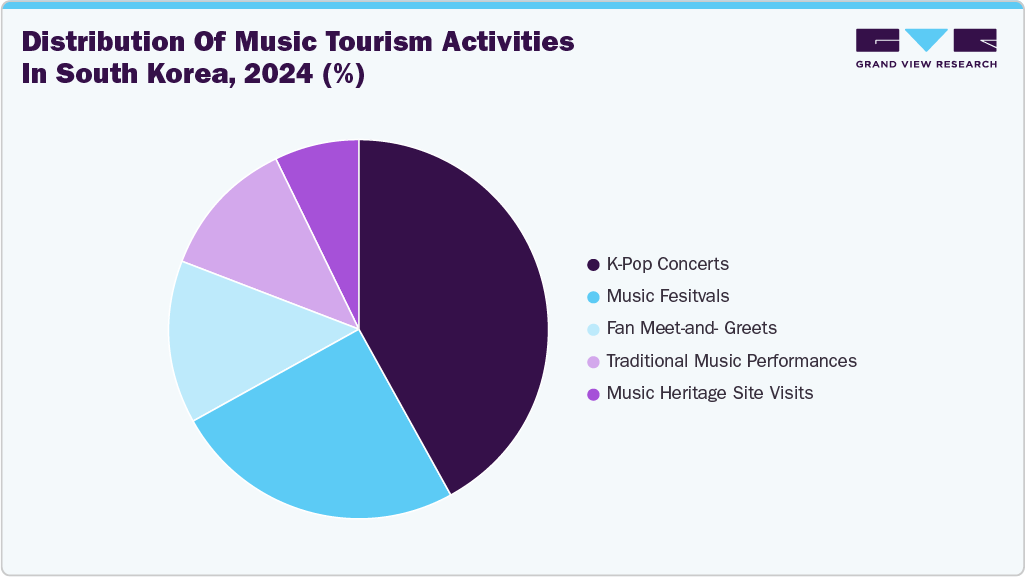
Traditional music performances, including gugak shows and local folk music experiences, represented about 12% of the tourism draw. Though niche, this category has shown gradual growth, especially among culturally curious travelers aged 35 and above. A significant 14% of respondents indicated traveling specifically for fan meet-and-greets, fan signing events, and idol-themed cafes-activities often concentrated in Seoul and Busan. These experiences often extend beyond concerts and promote longer visitor stays.
Finally, music heritage site visits, such as the K-pop Museum in Gyeongju and the Korean Music Hall of Fame, accounted for 7% of the preferences. These sites cater to both educational tourism and nostalgia-driven travel. These findings reflect a diversified but K-pop-centric market structure, indicating that investments in fan experiences and traditional genre promotion can broaden South Korea’s appeal further.
Event Insights
The concert category accounted for a revenue share of 52.33% of the South Korean music tourism industry in 2024. Concerts remain a dominant attraction due to their large-scale appeal and consistent scheduling in major cities like Seoul, Busan, and Incheon. International artists, as well as top-tier K-pop groups, frequently organize live performances that draw both domestic and foreign tourists. Moreover, the country’s well-established stadium infrastructure, accessible ticketing platforms, and promotional support from tourism boards have played a pivotal role in sustaining high footfall at concerts. The integration of AR/VR tech in some concerts has also enriched tourist experiences, contributing to this segment’s strong performance.
The festival segment is projected to grow at the fastest CAGR of 20.6% from 2025 to 2033. Annual music festivals such as the Seoul World DJ Festival, Incheon Pentaport Rock Festival, and Busan International Rock Festival have witnessed surging attendance post-pandemic. These events not only offer multi-day music experiences but also blend food, fashion, and culture, making them attractive to younger global audiences. The Korean government’s active efforts to brand such festivals as cultural exports and its support through K-culture tourism packages have further enhanced visibility. As festival tourism becomes more immersive and diversified, this segment is expected to witness exponential growth over the forecast period.
Booking Mode Insight
The online travel agencies (OTAs) segment held a dominant revenue share of 55.88% in 2024. The growing reliance on digital platforms, especially among international and younger domestic travelers, has significantly driven the popularity of OTAs. These platforms provide bundled music tourism packages including concert tickets, accommodation, transportation, and guided tours, streamlining the booking experience. Leading OTAs in Asia, such as Trip.com, Klook, and Interpark, have partnered with entertainment agencies and event organizers to offer exclusive access and early-bird bookings for music events, which has further elevated their appeal. The presence of multilingual interfaces, real-time customer support, and secure payment gateways has also contributed to the growing preference for OTA-based bookings.
The direct booking segment is anticipated to witness the fastest CAGR of 20.7% from 2025 to 2033. The rise in brand loyalty and demand for personalized travel experiences is encouraging tourists to book directly through official artist websites, concert organizers, or hotel and airline portals. Many K-pop agencies and music event brands are developing proprietary platforms that offer curated music tourism experiences, early access passes, and fan engagement perks. Direct booking is also supported by the growth of mobile apps and blockchain-based ticketing systems that reduce the risk of counterfeit passes. This segment is expected to gain further traction as event organizers seek to increase control over consumer data and create bespoke fan experiences.
Age Group Insights
The 18 – 34 years age group led the industry and accounted for a revenue share of 64.69% in 2024. This demographic remains the primary driver of music tourism in the country due to their high digital engagement, social media influence, and affinity toward contemporary music genres, especially K-pop, hip-hop, and electronic. Younger travelers are more inclined to travel for live performances, festivals, and pop culture events, often planning trips around concert schedules. The ease of international travel, flexible itineraries, and the popularity of Korea’s entertainment industry among Gen Z and millennials globally have significantly boosted this segment. Additionally, music tourism packages offered by travel agencies often target this age group through digital channels and influencer partnerships.
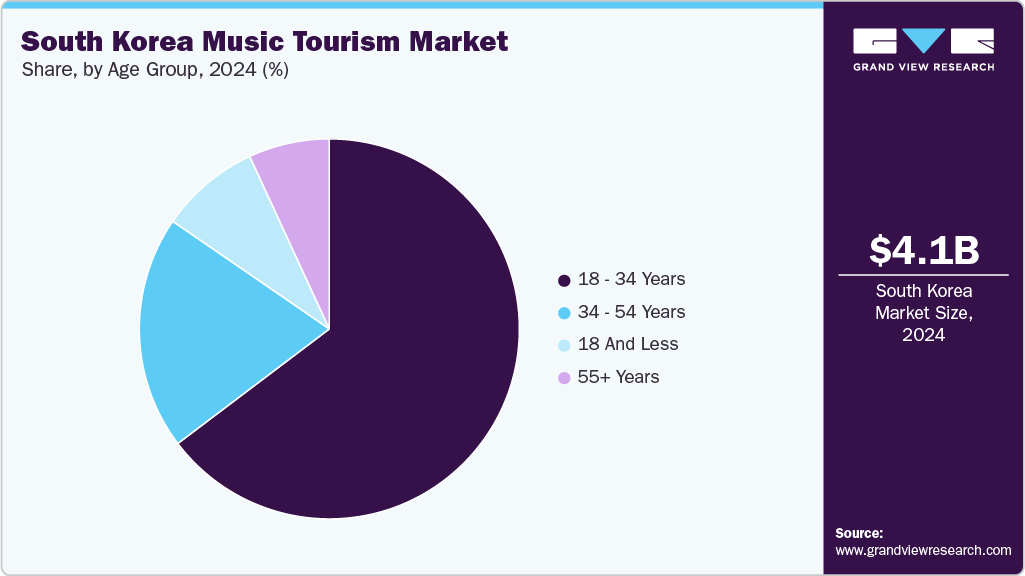
The 34 – 54 years segment is projected to grow at the fastest CAGR of 21.1% from 2025 to 2033. This growth can be attributed to a rising wave of nostalgia-driven tourism, with travelers in this cohort showing interest in legacy pop, rock, and ballad concerts, as well as jazz and classical music events. Many in this group also accompany younger family members, contributing to multigenerational tourism growth. With increasing disposable incomes and a growing preference for culturally immersive experiences, this age group is also engaging with music tourism through wellness-integrated or premium travel offerings. Tour operators are capitalizing on this shift by curating experiential and comfort-oriented packages tailored to mature travelers.
Key South Korea Music Tourism Companies Insights
Key players operating in the South Korea music tourism market are undertaking various initiatives to strengthen their presence and increase the reach of their products and services. Strategies such as expansion activities and partnerships are key in propelling the market growth.
Key South Korea Music Tourism Companies:
- Nol Universe Co., Ltd.
- NHN LINK Corporation
- YES24 CORP
- SM CULTURE& CONTENTS CO., LTD.
- HYBE
- JYP Entertainment Corp.
- YG Entertainment
- Live Nation Entertainment
- Kakao Entertainment
- CJ ENM Co., Ltd
Recent Developments
-
In May 2025, as part of the pre-opening festivities, Classic Busan organized free outdoor “Classic Park Concerts” on June 7-8. Featuring soprano Jo Sumi and conductor Chung Myung‑whun with the KBS Symphony, these events were designed to introduce classical music to both locals and inbound visitors in a scenic, accessible setting.
-
In April 2025, BOF was reimagined as a broad K‑Culture tourism event. Running June 11-13, it now includes a BIG Concert (e.g., NCT WISH, SUPER JUNIOR), a band concert, Park Concerts, fan city zones, K‑content talks, and local markets. This diversified format enhances engagement with international tourists and deepens Busan’s position as a cultural hotspot.
-
In February 2025, Busan unveiled its first-ever classical music venue, featuring a 2,011-seat main hall, a 400-seat chamber space, and the region’s only pipe organ, all nestled in Citizens Park. The hall opens June 20-28 with a star-studded festival led by maestro Chung Myung‑whun, including performances of Beethoven’s Symphony No. 9 and organ recitals. This marks a major leap in attracting classical-music tourists beyond Seoul.
South Korea Music Tourism Market Report Scope
|
Report Attribute
|
Details
|
|
Market size value in 2025
|
USD 4,917.6 million
|
|
Revenue forecast in 2033
|
USD 21,579.3 million
|
|
Growth rate
|
CAGR of 20.3% from 2025 to 2033
|
|
Actual data
|
2021 – 2024
|
|
Forecast period
|
2025 – 2033
|
|
Quantitative units
|
Revenue in USD million/billion and CAGR from 2025 to 2033
|
|
Report coverage
|
Revenue forecast, company ranking, competitive landscape, growth factors, and trends
|
|
Segments covered
|
Event, age group, booking mode
|
|
Country scope
|
South Korea
|
|
Key companies profiled
|
Nol Universe Co., Ltd.; NHN LINK Corporation; YES24 CORP; SM CULTURE& CONTENTS CO.,LTD.; HYBE; JYP Entertainment Corp.; YG Entertainment; Live Nation Entertainment; Kakao Entertainment; CJ ENM Co., Ltd
|
|
Customization scope
|
Free report customization (equivalent up to 8 analysts working days) with purchase. Addition or alteration to country, regional & segment scope
|
|
Pricing and purchase options
|
Avail customized purchase options to meet your exact research needs. Explore purchase options
|
South Korea Music Tourism Market Report Segmentation
This report forecasts revenue growth at the country level and provides an analysis of the latest industry trends and opportunities in each of the sub-segments from 2021 to 2033. For this study, Grand View Research has segmented the South Korea music tourism market report based on event, age group, and booking mode:
-
Event Outlook (Revenue, USD Million, 2021 – 2033)
-
Age Group Outlook (Revenue, USD Million, 2021 – 2033)
-
18 and Less
-
18 – 34 Years
-
34 – 54 Years
-
55+ Years
-
-
Booking Mode Outlook (Revenue, USD Million, 2021 – 2033)
-
Direct Booking
-
Travel Agents
-
Online Travel Agencies
-
Frequently Asked Questions About This Report
b. The South Korea music tourism market was estimated at USD 4,114.8 million in 2024 and is expected to reach USD 4,917.6 million in 2025.
b. The South Korea music tourism market is expected to grow at a compound annual growth rate of 20.3% from 2025 to 2033 to reach USD 21,579.3 million by 2033.
b. The concert category accounted for a revenue share of 52.33% of the overall South Korea music tourism market in 2024. Concerts remain a dominant attraction due to their large-scale appeal and consistent scheduling in major cities like Seoul, Busan, and Incheon.
b. Some of the key players in the South Korea music tourism market include Nol Universe Co., Ltd.; NHN LINK Corporation; YES24 CORP; SM CULTURE& CONTENTS CO.,LTD.; HYBE; JYP Entertainment Corp.; YG Entertainment; Live Nation Entertainment; Kakao Entertainment; CJ ENM Co., Ltd.
b. The South Korea music tourism market is driven by the global influence of K-pop, traditional music, and vibrant live performance culture. As the Korean Wave (Hallyu) continues to gain momentum, music-related travel has become a strong motivator for international and domestic tourists alike.
link