The number of Russians travelling to North Korea has risen by a third in the past year as they enjoy empty beaches, chaperoned excursions and a touch of nostalgia for the Soviet Union.
Russians made 9,985 trips to the secretive dictatorship last year, the highest figure since the Federal Security Service (FSB) began publishing such statistics in 2010, and double the amount a decade ago.
More than half, or 5,075, of those trips were classified as tourism, with the remainder involving travel for business or personal reasons, or for vehicle maintenance.
The overall number of trips fell to 41 in 2021 and 73 in 2022, during the pandemic, but climbed in 2023 to 1,238 visits, then rose sharply to 6,469 in 2024, when North Korea reopened its borders to Russian tourists after the pandemic.
The increased tourism flow last year may have been linked to the opening in summer of the Wonsan Kalma coastal tourist area in Kangwon province, although it is unclear how many Russians reached it.
Kim Jong-un attended the opening ceremony and was pictured at a fireworks display, and sitting outdoors at a table with a cigarette packet and an ashtray as he surveyed a tourist flying out of a water slide.

Kim Jong-un and his daughter, Kim Ju-ae, during a ceremony to celebrate the completion of the Wonsan Kalma coastal tourist zone
KCNA/REUTERS
His daughter, Kim Ju-ae, and his wife, Ri Sol-ju also attended, and the then Russian ambassador, Aleksandr Matsegora, was a special guest.
• Kim Jong-un is ‘training’ next dictator — his own daughter
North Korean state media said the resort could accommodate 20,000 guests and was part of the ruling party’s efforts “to bring about the shining efflorescence of socialist civilisation on our land”.
Wonsan was also described as the “brilliant fruition of the profound thinking and undying efforts” of Kim who “saw to it that all the edifices are perfectly created”.
Anastasia Samsonova, 33, a human resources worker, was among the 15 Russian tourists who were the first foreigners to visit the resort in July. She told the BBC that “everything was immaculate” and she “enjoyed a vacation without people”.

Domestic tourists at a beach in Wonsam
KIM WON JIN/AFP/GETTY IMAGES
An eight-day tour to Wonsan including flights from Vladivostok, hotel and food would cost about 150,000 roubles (£1,400) per person, one Russian tour agency said at the time.
The Wonsan resort consists of high-rise hotels around a long sandy beach. There are also a water park and shopping malls. The first tour group of 13 Russians visited in early July, at the same time as Sergey Lavrov, Russia’s foreign minister, met Kim in the city and said he was sure more Russia tourists would be “eager to come”.
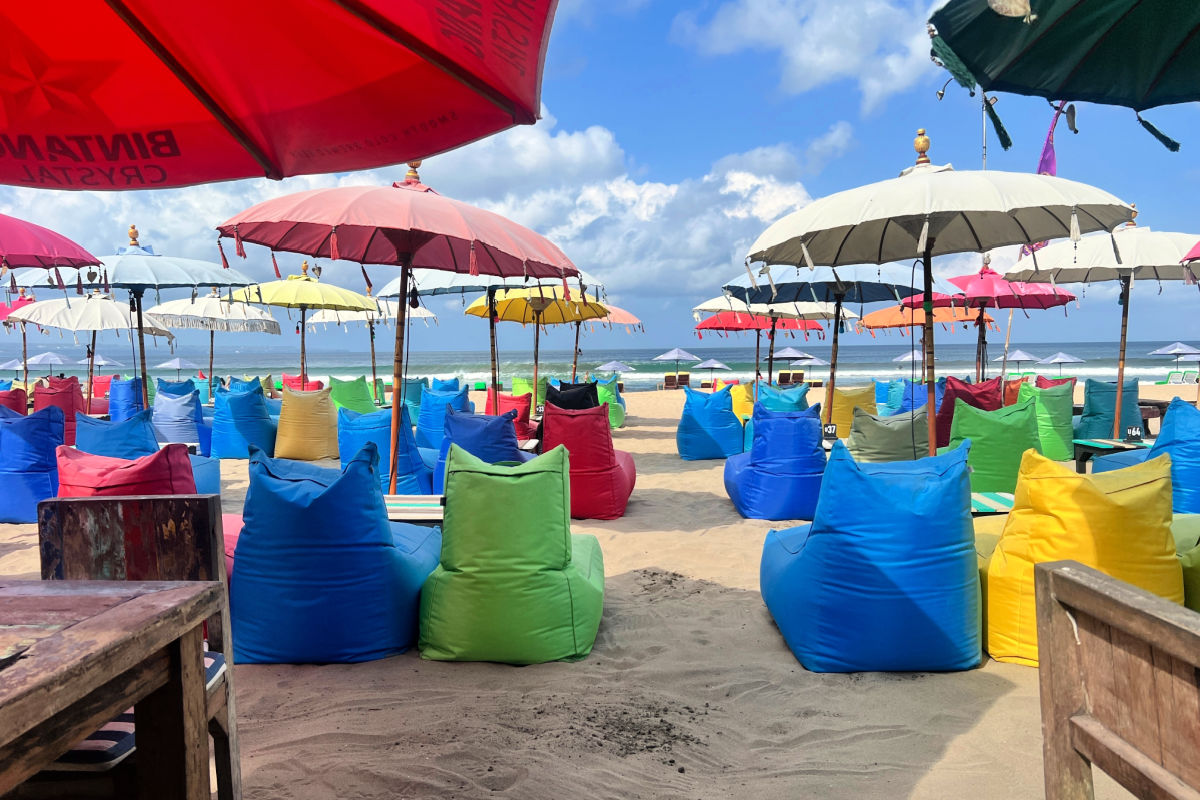
Members of the Russia tour group said they had been effusively received. “We’ve been to a lot of places. We were in Bali three months ago. But this is real relaxation,” one guest told Russia’s RBC news agency.
“I’ve never said anything like it,” said another. “You say you’d like some music and someone is instantly bringing you a speaker.”
However, a week after the group’s visit, North Korea’s tourism ministry announced the resort had been temporarily closed to foreigners, and reports suggest the restriction has not been lifted since.
It is thought that North Korean officials were unsettled by media reports about the Russians’ visit suggesting it was tightly choreographed.
An RBC correspondent had noted that the resort was completely quiet before the Russians arrived at their hotel, but when they did at 8.30am crowds of Koreans suddenly appeared on the beach with blow-up rings, although the children did not go in the water. A Korean man and woman were also noted to be permanently playing billiards in a hotel where reporters were staying, though they stepped away from the baize as soon as the journalists moved out of view.
Despite the temporary closure at Wonsan, Russians have continued to be allowed visits to other areas in North Korea, according to regional media.
Several Russian tourists who spoke to the media or blogged about their journeys said the feel of North Korean restaurants and hotels, and the lack of street advertising, recalled the simple pleasures of tourism inside the Soviet Union.

Several Russian tourists have blogged online about their trips to North Korea

Darya Tarasenko, 31, a real estate specialist from Moscow, recently told the Life News website that she had found her trip in May last year fascinating, and she saw the country as a “unique scrap of land, deliberately kept under a cupola”.
Opportunities to walk outside had been limited to five or six minutes, and her group were always accompanied by a guide and a secret policeman, who the tourists called “KGBshnik” in a reference to the Soviet KGB.
Ilya Voskresensky, a popular video blogger from St Petersburg, said he had “landed in a parallel universe” on his trip to North Korea last year.
“You have the impression of a show being created for tourists,” he said, likening the experience to playing inside the confined zone of a computer game. “You can walk around it but you’re not allowed beyond the boundary. It’s all fake and beyond [the edge] is just an abyss. Or a wall.”
Russia and North Korea, which share 11 miles of border and a single railway link across the Friendship Bridge near the Sea of Japan, have cultivated closer ties since President Putin launched his full-scale invasion of Ukraine in 2022, prompting isolation from the West.
Putin visited the North Korean capital, Pyongyang, in 2024 for the first time since 2000. North Korea has provided troops, missiles and artillery for Moscow’s war on Ukraine, while Russia has supported Pyongyang’s development of nuclear capabilities.
Russia and North Korea also agreed in June last year to restart the longest direct train journey in the world, from Moscow to Pyongyang, after a four-year hiatus. The route is more than 6,000 miles long.
link