President Lee Jae Myung’s four-nation swing through the Middle East and Africa, culminating at the G20 summit in Johannesburg, South Africa, signaled a strategic recalibration in Seoul’s foreign policy, diplomatic analysts said Sunday.
Driven by the imperative to secure supply chains for critical minerals and energy, the trip provided momentum for the administration’s efforts to forge deeper ties with the Global South and expand Korea’s international responsibilities.
The Global South is a term often used for the collective grouping of developing economies across Africa, Latin America, Asia, Oceania and the Caribbean.
This strategic recalibration reflects Seoul’s efforts to broaden its diplomatic portfolio, presenting itself as a steady partner in Africa and elsewhere, and actively working to reduce its vulnerability to geopolitical disruptions in global trade.
During the first session of the multilateral gathering on Saturday (local time), Lee called the first G20 summit to be held in Africa “highly meaningful” and expressed support for the African Cooperation Framework, a multilateral initiative aimed at promoting sustainable development across the continent.
On trade, he urged G20 nations to work toward revitalizing the World Trade Organization to boost global growth, noting that the international trade body “serves the interests of all nations.”
His remarks came as Korea seeks to strengthen its standing as a responsible global player and to help create the conditions necessary to restore the multilateral trade system.
Doo Jin-ho, head of the Eurasia Research Center at the Korea Research Institute for National Strategy, said the G20 meeting provided a timely diplomatic opportunity for the Lee administration. The summit came roughly a year after Korea faced political turmoil from then-President Yoon Suk Yeol’s abrupt declaration of martial law last December.
“Through the president’s presence at the G20, a forum that brings together the world’s major economies, the government was able to showcase Korea’s fully restored democratic resilience after the impeachment crisis,” Doo said. “It has also signaled that the nation’s ties with the Global South will strengthen under his administration.”
Doo noted that the Global South is emerging as an alternative framework to the G7, a bloc of wealthy nations, and thus is becoming an increasingly important diplomatic partner for Seoul.
“The Lee administration cannot achieve its vision of becoming a globally responsible power without engaging these actors,” he said.

President Lee Jae Myung and leaders of G20 member countries pose during the G20 summit in Johannesburg, South Africa, Saturday (local time). Reuters-Yonhap
This year’s G20 was particularly significant as leaders adopted a joint statement at the start of the summit, despite opposition from the United States, which boycotted the two-day talks amid a diplomatic rift with the host country.
The 122-point declaration called for coordinated global action on climate-related disasters, rising sovereign debt, food security challenges and securing supply chains for critical minerals to support inclusive growth.
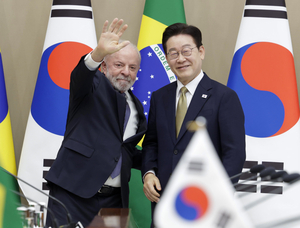
On the sidelines of the summit, Lee held bilateral meetings on Saturday with Indian Prime Minister Narendra Modi and Brazilian President Luiz Inacio Lula da Silva — two major leaders of the Global South.
According to the presidential office, Lee told Modi he hopes to strengthen cooperation and people-to-people exchanges across economic, cultural and security fields. Modi, in turn, emphasized expanding cooperation in shipbuilding and invited Lee to visit India.
In his meeting with the Brazilian leader, the Korean president discussed social and economic issues such as income distribution and development policy.
Lee also met with the leaders of Mexico, Indonesia, Turkey and Australia — the MIKTA grouping. Together they reaffirmed their commitment to strengthening cooperation amid supply chain disruptions, geopolitical tensions and other shared challenges.
Lee hosted the meeting as Korea has served as the rotating chair of MIKTA since February.
“Leaders shared deep concern over the complex, multifaceted challenges confronting the international community, such as continued geopolitical tensions, global economic uncertainties, supply chain complexities, poverty and inequality, multiple environmental crises including the climate crisis and accelerating digital transformation,” the joint statement of the MIKTA leaders said.
“Amid this reality, leaders reaffirmed MIKTA’s shared commitment to promoting multilateralism and international cooperation, defending democracy and upholding international law.”
link